The Southern California Augmentative and Alternative Communication Network...

...is a support group for professional development, problem solving, leadership, mentoring, and training in the use of augmentative and alternative communication (AAC) to develop communication in non-speaking and minimally verbal individuals in the Southern California Region.

Follow this blog via email at the right.
Join our email list: socalaacnetwork@gmail.com
Friend us on Facebook SoCal AAC
Follow us on Twitter @SCAACN

Thursday, May 17, 2012

QUAD Profile in Early Language Therapy - Thanks Kara!


Kara Bidstrup referred to the QUAD© Profile in her presentation at the SCAAC-N Spring Quarterly meeting Tuesday. Download the QUAD© Profile HERE.
Particularly useful elements to guide our language therapy for our AAC users:
Sentence Types Checklist - Where your sample consists of sentences, or attempts at sentences, check off any occurrences of the basic sentence types. Use tally marks on the sheet if you want to see the frequency with which the different types are used.
Language Functions Checklist - For each sentence (or single-word ‘sentence’) check off the function that the utterance performs. There may be some ambiguity and a certain amount of interpretation needed.
In the author's words...
The QUAD© Profile is a simple analysis tool that allows you to take a sample of language and compare it against a set of checklists. The checklists look at four levels of language:
      • Vocabulary – the words an individual uses to build sentences
      • Morphology – the way words change within a sentence
      • Syntax – the order of words in a sentence
      • Function – what the purpose of a sentence is
The profile does not give a score and is not intended to do so. However, there are some norms provided so you can get a general idea of where a client is succeeding or having difficulties.

SCAAC-N Spring Meeting Notes - 5/15/12

Tuesday's Southern California AAC Network meeting at Villa Esperanza Services in Pasadena was well attended and received (19 participants; 4 from Villa Esperanza! 5 representatives from the San Gabriel USD!!). Kara Bidstrup presented valuable information on language therapy in AAC.

 Download the entire handout HERE.


Boardmaker Share - Hungry anyone??

Take a nibble at some of these food-related visual supports on BoardmakerShare.com


Wednesday, May 16, 2012

SIG 12: Resources on iPad AAC apps

From Jessica Currall, MS/CCC-SLP (AAC Research & Outreach Coordinator, Pennsylvania State University) via ASHA's SIG 12, AAC Digest for Tuesday May 15, 2012

This webcast is specific to "Mobile Devices and Communication Apps: Current Trends and Future Directions" (http://aac.psu.edu/?p=841) and is a discussion among Dr. David McNaughton (from Penn State), Howard Shane and Jessica Gosnell from Boston Children's Hospital, and Sam Sennott, one of the original developers of Proloquo2Go and who is currently pursuing his PhD at Penn State.  The discussion includes:  Benefits of Mobile Communication Technology; the Assessment Process; Learning about New Apps; Intervention; Building Vocabulary and Language Skills; What's Next?; and Additional Resources.

Referenced in the webcast and also provided for free through Boston Children's Hospital is a feature matching chart that they have developed (and continue to do so on-going) to support the process of considering what the individuals needs are with what the various demands/opportunities there are with a wide variety of apps for mobile technologies. You can find this at:  http://www.childrenshospital.org/clinicalservices/Site2016/mainpageS2016P19.html.

Sam consistently argues that as powerful a tool as the iPad and Mobile Technologies are, they remain a ~part~ of a process of dynamically considering the individual communicator's needs, the environment, the situation, and *then* what tool best supports the communication and learning.  This approach may be summarized in academic settings with the the acronym, SETT:  Student Environment Task Tool.  Sam reviewed this and other areas with the iPod Touch and iPad at his 2009 presentation at the ASHA convention.  I attached the handouts, which are available through ASHA.  Sam also has an on-demand web seminar on using mobile apps in clinical practice available through ASHA (at cost) at:  http://www.asha.org/eweb/OLSDynamicPage.aspx?Webcode=olsdetails&title=Using+Mobile+Apps+and+Social+Media+in+Your+Practice+(On+Demand+Web+Seminar)

The AAC-RERC has also put together a comprehensive White Paper on Communication Apps that goes through the history of AAC, the history of communication Apps, areas that are considered benefits/gains/value-added, and areas that remain underinvestigated or raise concerns:  http://aac-rerc.psu.edu/index.php/pages/show/id/46


Tuesday, May 15, 2012

Minspeak E-Newsletter, Issue 49


If you're having trouble viewing this email, you may see it online.
Share This:
Send to Friend
May 15, 2012
  • Pixon Teaching Tip: Many children with emerging language confuse the ideas of “asking” vs. “telling,” making it challenging to help them learn how to ask questions of others. To help them learn about “asking,” create a simple, laminated paper prop, such as a 6 x 8 Prompt Card with the Pixons for “ask” and “question.” When the person has a question to ask, write the question on the back of the Prompt Card using a dry-erase marker and have him/her hand the other person the card. The person answers the question. Then asks the same question as he/she hands the card back to the student. This type of picture exchange may help the person understand his/her role in the question asking process, while learning the Pixon picture.

  • Intervention Planning: Create communication opportunities this week to encourage your person using Minspeak to ask questions. Select 1 or 2 things you will do this week (e.g., change your routine, create barriers, use sabotage, etc.) and use them in your daily routine, providing repetition with variety. Encourage question asking through modeling, environmental cues, and specific prompts. If necessary, create a simple script for what you will do.

  • Teaching Materials Exchange: Celebrate Memorial Day with a book that asks 6 questions about this holiday. This books is coded with Pixons and icon sequences from Unity®45, Unity®60, Unity®84, and Unity®144.

  • Pittsburgh Language Seminar Series: Check your calendars to see whether or not you can attend one of the upcoming seminar series. June 19-21 will feature presentations by Seminar Alumni with topics including specific implementation strategies and ideas for families, teachers, therapists and individuals using Minspeak. There will be no seminars in July and August, but they start up again in September. September’s seminar (11th-13th), will feature Caroline Musselwhite as the guest speaker. All of these seminars are provided free of charge, with meals and lodging provided. To register, contact Renee McGough immediately at 412-885-8541 x105 or email her at rmcgough@minspeak.com.

  • Announcements: Don’t forget to register for the ISAAC conference!


Benefits of Minspeak
Using multi-meaning icons.
The power of motor automaticity.


Use of Minspeak
Minspeak systems with different disabilities.
Minspeak and cultural-linguistic diversity.


The Power of Minspeak
Minspeak, language and literacy development.
Using Minspeak in the classroom.


Support of Minspeak
Strategies to support use of Minspeak.
Minspeak teaching materials.


Visit us online www.minspeak.com
© Semantic Compaction Systems 2009
1000 Killarney Drive, Pittsburgh, Pennsylvania 15234, USA.
Tel. 412.885.8541 Fax 412.885.8548
This message was intended for: gmeier@villaesperanzaservices.org
Got this as a forward? Sign up to receive our future emails.
Unsubscribe
Home Contact Us Minspeak What is Minspeak Who Uses Minspeak Why Use Minspeak Demo Minspeak Lives Transformed Through Minspeak

Friday, May 11, 2012

SCAAC-N Quarterly Meeting - Tuesday, 5/15/12

Join us next Tuesday, May 15, from 6:30-8:30 as Kara Bidstrup, MA, SLP (Prentke Romich Co.) presents:

From “eat cookies” to Asking Questions:  Getting beyond simple requesting through AAC language therapy

FREE! as always. Bring a colleague. Forward this email.

Some topics Kara will cover:

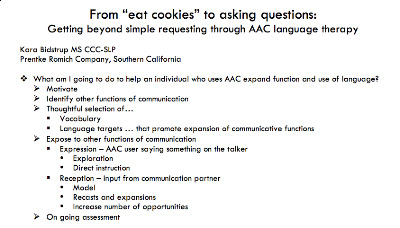
What am I going to do to help an individual who uses AAC expand function and use of language?
     Motivate
Identify other functions of communication
Thoughtful selection of…
§  Vocabulary
§  Language targets … that promote expansion of communicative functions
Expose to other functions of communication
§  Expression – AAC user saying something on the talker
·      Exploration
·      Direct instruction
§  Reception – input from communication partner 
·      Model
·      Recasts and expansions
·      Increase number of opportunities
On going assessment

Where: Villa Esperanza Services, Braun Conference Center
2116 E. Villa Street, Pasadena, CA 91107
Brick building on the corner of Villa and Craig
Ample street parking

When: Tuesday, May 15, 2012
6:30-8:30 p.m.

Agenda
6:30-6:45 Networking, snacks & beverages
6:45-8:30 Presentation

Wednesday, May 9, 2012

AAC 101 Webinar (YouTube, 1 hour)

This webinar will provide a broad overview of Augmentative and Alternative Communication (AAC). The topics will include communication basics, AAC terminology/ concepts and a brief overview of intervention models.

Presented by Karen Coulter, Ph.D, CCC-SLP, A.T.P. Weisskopf Child Evaluation Center, University of Louisville