The Southern California Augmentative and Alternative Communication Network...

...is a support group for professional development, problem solving, leadership, mentoring, and training in the use of augmentative and alternative communication (AAC) to develop communication in non-speaking and minimally verbal individuals in the Southern California Region.

Follow this blog via email at the right.
Join our email list: socalaacnetwork@gmail.com
Friend us on Facebook SoCal AAC
Follow us on Twitter @SCAACN

Monday, August 13, 2012

Research: Online Training for Paraeducators...[in AAC]

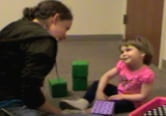
child with teacher
Douglas, S., Light, J., & McNaughton, D. (July, 2012).  Online Training for Paraeducators to Support the Communication of Young Children with Complex Communication Needs.  Presentation at 15th Biennial Conference of the International Society for Augmentative and Alternative Communication (ISAAC) in Pittsburgh, PA....

...This research project examined the effect of online training for paraeducators to support the communication of young children with CCN during play and generalization activities. The content of training was driven by research in early childhood development and communication and based on research in the area of communication partners as summarized by Light and Drager (2010). During the online training paraeducators were taught the three steps of the  PoWR strategy.

1) Provide opportunities for communication
-
included teaching paraeducators to provide multiple communication opportunities to their target child by asking questions, commenting about the activity, and providing choices (Fox et al., 1997).

2) Wait for child’s communication
-
paraeducators learned to wait for at least five seconds after offering a communication opportunity so the child had adequate time to respond (Downing, 2005; Klein, Cook, & Richardson-Gibbs, 2001; Otto, 2010).

3) Respond to child’s communication
-
taught paraeducators to respond when the child communicates, even if the communication is unclear (Allen & Hart, 1984; Cress & Marvin, 2003; Snell, 2002; Snyder & Sheehan, 1996; Zangari & Kangas, 1997).  If the child did not communicate after five seconds, the paraeducator was taught to provide another opportunity for communication....
(read the entire article HERE)

Saturday, August 11, 2012

SCAAC-N Summer Meeting Notes - 7/24/12

Many thanks to Darlene Hanson and Mei Mei (Rebecca) Liu for sharing their insights into the real world of making assistive technology work for a non-speaking student in general a education high school setting. Mei Mei composed a PowerPoint presentation from her perspective for an assistive tech conference earlier this year. The following bullets are from Mei Mei's perspective.

Technology ... "changes everything"
  • She previously relied on an Alphasmart and a Franklin (palm-sized dictionary that allows typing)
  • The touchscreen of the iPad is less tiring than the devices with keys to depress
  • The Assistive Chat text-to-speech iPad app is her "voice" and her friends at school recognize that voice as hers
  • CD ROMs read aloud to her (she is an auditory learner)
  • Dropbox (online file storage) is used to transfer files between school-home
  • The iPod and iPhone serve as supports for sensory breaks during the school day, as well
  • Without technology, Mei Mei imagined that she could not function at school at all, she would be trapped inside her head and unable to show anyone her intelligence, and unable to "live in the real world."
Low Tech Supports still in use:
  • Token boards
  • Number and letter boards for math and multi-choice questions in class (ABCD choices)
  • Yes/No card out of any scrap of paper when in the community (her vocal responses are inconsistent)
 Challenges: 
  • Lack of independence
  • Set up is required for class materials and devices
  • Speed when typing
  • Reliance on aide to manage behaviors 
  • Restrictions on district-owned equipment (Pasadena Unified) prevent internet access so that sharing documents, primarily class notes, to her home computer for home work is complicated.
Mei Mei soldiered on, despite the fact that the timing of this event was not ideal based on personal circumstances. Some of the participants commented that Darlene's verbal prompts to Mei Mei regarding regulation were helpful to see and may be applicable to the individuals they work with. 

These included:
- Fix your body
- Use your eyes and hands together
- 3...2...1 (countdown to movement)


Thanks again, Darlene and Mei Mei! 
Please join us in Pasadena at our next Quarterly meeting (date TBA, October/November 2012).

Communication Options Using the iPad

The Back to School Conference was a great success! 
225 attended, 30 of which were SLPs.
 
My Friday session on Communication Options was entirely too brief, and could have filled an afternoon.  I showed a number of screen shots while explaining basic, inexpensive apps and wanted to share the entire presentation HERE (click to download and view the show).  The handout summarized the information with far fewer visuals. Click HERE to download the handout.

The Mysterious Power of Music - Notes


Thank you to all of the participants at the “Back to School” session on August 10. I couldn’t have done it without your great ideas!! Click HERE to download the handout, including the additional notes.

- Gwendolyn
---------------------------------------------------------------

 Additional Notes, that I promised I would post, from 8/10/12:

Tunes for Teens
For music-interested teens and adults, these 11 Repetition not Rhyme tunes may feel too juvenile. Instead try:
·      Chanted rhythms
·      “Brush Your Teeth” (Raffi, http://www.youtube.com/watch?v=Y1hlHked0LM )
·       Baby Shark Song (Scout Song, http://www.youtube.com/watch?v=rqV1O5eeA9Y)
·      Karaoke versions of popular songs
From the Audience: One Mom prompted her son to get his shoes and get out the door using the theme song from Angry Birds (listen to it on YouTube- http://www.youtube.com/watch?v=DehK_Y0TUbE) with the following lyrics:
Time to go now, time to go now
Quickly get your shoes its time to go now

A song for calming
When you sing, you are required to take in more air and breathing naturally slows. Your vocal chords are tightened in order to control the melody of your song, a greater volume of air is required in order to vocalize, and the exhale period is longer when singing than when speaking. Deep breathing is often recommended for calming, but can be a challenge to induce in an individual who is feeling anxious or over-stimulated. If an individual can participate in singing a song or phrase, it will promote deep breathing.  Any song will do, but we wrote the following as a group:
(London Bridge tune)
I know how to take a breath, take a breath, take a breath.
I know how to take a breath. Watch me now.

Story-time attention getter
Some students struggle to attend to more passive classroom activities such as book reading. An example of reading the Very Hungry Caterpillar was provided with the periodic chant (while patting your thighs): He’s hungry! He’s hungry! He’s really, really hungry!  Adding drama and high affect in your face and voice also doesn’t hurt when gaining and sustaining attention!

A song for raising your hand
Before a Q&A activity in the classroom, it may be helpful to prime students with a reminder to raise their hand using a song. One option may sound like this:
(Mulberry Bush)
Don’t forget to raise your hand, raise your hand, raise your hand.
Don’t forget to raise your hand, when you want a turn.
Periodic reminders could take the form of a short, chanted phrase just before it’s time to raise hands: (drum roll patted on thighs) Raaaaaise yooooooour hand!

Two songs for trying new foods
One Mom has been singing a Farmer In the Dell song to encourage and sing about trying new foods with verses that describe what a food might feel like in the mouth. I may have used a little creative license (aka. short term memory failure) with the lyrics.
(Farmer In the Dell)
I like to try new foods, I like to try new foods,
I feed my body everyday,
I like to try new foods.

An apple, it goes CRUNCH. An apple, it goes CRUNCH.
I feed my body everyday,
An apple, it goes CRUNCH.

I imagined a song that might turn new food exploration into a sneaky game of anticipation using the Scout’s song Baby Shark. Watch a video of it here: http://www.youtube.com/watch?v=rqV1O5eeA9Y The pattern of this song is not unlike Raffi’s Brush Your Teeth song (which uses a bit of rhyme, but it can be re-written without it!). Hear Raffi sing it: http://www.youtube.com/watch?v=Y1hlHked0LM
(Baby Shark Song)
I have an apple, doo-doo, uh, doo-doo
A little apple, doo-doo, uh, doo-doo

It’s on my plate, doo-doo, uh, doo-doo

It’s on my lips, doo-doo, uh, doo-doo (2xs)
It’s on my tongue, doo-doo, uh, doo-doo (2xs)
I’m gonna eat it, doo-doo, uh, doo-doo (2xs)
I put it in, doo-doo, uh, doo-doo (2xs)
I make it crunch, doo-doo, uh, doo-doo (2xs)
And then I swallow, doo-doo, uh, doo-doo (2xs)
Hooray!

Thursday, August 9, 2012

Recruiting SLPs/Teachers for Study: IEPs for AAC ($150)

From: Melanie Fried-Oken
To: SIG 12, AAC
Posted: August 8, 2012, 4:04 PM

[Researchers at Oregon Health & Science Univerity] are looking for school-based SLPs and special educators who will be completing IEPs by December 2012 for K-12 students who rely on AAC. As subjects, you will  receive $150 gift card for your anonymous participation (which should take about an hour)...Thanks, and enjoy the beginning of your school year!

If you are interested, please read the info from the flyer (included below) and email ICFAAC@ohsu.edu. 

-----------------------------------------------

Our Research Project, “Using the ICF-CY to Guide Communication Instruction for Learners Who Use AAC (Augmentative and Alternative Communication),” is seeking school-based Speech-Language Pathologists and Special Educators who:
·      Currently work at least weekly with one student with complex communication needs in grades K-12.
·      Are responsible for developing communication-related IEP goals for the student with complex communication needs in grades K-12.
You will be randomly assigned to one of two groups.  The first group will use the ICF-CY for AAC Profile, a new tool designed to make IEP goal writing easier, for the target student and create a report before developing the student’s 2012-13 communication-related IEP goals.  The other group will use any means that they normally use to develop goals.  No identifying information will be collected about the student. Both groups will provide the de-identified communication-related IEP goals and complete a feedback survey about the process. 
It should take no more than two hours to complete the requested activities. All participants will receive $150 Target gift card upon completion of study tasks.


If you are interested in participating in this study, please contact: ICFAAC@ohsu.edu and indicate:
1.     Whether you are a Special Educator or a School-based Speech-language Pathologist
2.     When you anticipate the 2012-2013 IEP meeting for this student (day, month and year)
3.     The age and grade of the target student

Wednesday, August 8, 2012

Survey (Weigh In!): Assistive Tech training needs

The AT Network is conducting an exciting statewide project to provide quality Assistive Technology training options for a variety of communities and we need your help!

Disability community members, advocates, families, educators, and AT stakeholders are invited to share your assistive technology training needs. Responses will be used to develop new training topics.  It would be greatly appreciated if you can take a moment to complete the survey no later than Wednesday, August 22, 2012.  There are nine (9) questions and all responses are anonymous.

Should you have any questions or have trouble accessing the survey please don't hesitate to contact Rosemarie Punzalan via email at rosemarie@cfilc.org.

Tuesday, August 7, 2012

Pasadena NOW: Villa Esperanza!

Villa Esperanza’s Tech-savvy Speech and Language Center Uses Innovative Ipad Applications

Villa's Hjelte-Phillips Speech and Language Center, under the direction of Gwendolyn Meier is dedicated to giving a voice to individuals who are nonverbal

from STAFF REPORTS
Published: Monday, August 6, 2012 | 12:35 PM


Samantha, a Villa student, also works with Gwendolyn Meier on gaining communication skills using the Ipad.

Vanessa is a high school student at Villa Esperanza Services’ School located in Pasadena.
She doesn’t speak, but instead spent the first 16 years of her life communicating primarily by flipping her hand at the side of her leg to say “Hi,” waving her hand at her waist when she needed to go to the restroom, and screaming while bouncing up and down in her seat both when excited and when distressed.

Villa’s speech and language clinicians worked with Vanessa for years to teach and develop recognition and pointing skills so that she could utilize pictures to help her communicate. Once she had gained some basic skills, an evaluation revealed that Vanessa could benefit from assistive technology in the form of augmentative and alternative communication (AAC).

Villa Esperanza Services knows the importance of staying current with the latest technologies. Villa’s Hjelte-Phillips Speech and Language Center, under the direction of Gwendolyn Meier, MA, CCC-SLP, MT-BC, is dedicated to giving a voice to individuals who are nonverbal; and they are doing so at the touch of a screen. Using “apps” for the iPad and iPod, Villa’s clinicians are helping individuals with autism across a broad spectrum of communication and educational challenges.
Due to the prevalence and relative affordability of the iPad, more students than ever before are being assessed for computer-based augmentative and alternative communication (AAC) systems.

Students with autism often become adept with the touch screen interface by playing games and videos on family iPhones, iPods and iPads. These basic skills can often be shaped into meaningful communication when an appropriate app and treatment plan are implemented by a trained AAC professional. Before the iPad, the expense of traditional, high tech speech-generating devices for nonverbal individuals (e.g., $4,000-8,000) prevented many with autism from accessing these technologies. These days, the purchase of an iPad and appropriate communication apps can cost as little as $600.